

It’s a classic conundrum: setting ambitious goals at the start of a new year, only to find that the ones made the year before were left untouched, or started with fervor but then quickly forgotten. But although New Year’s resolutions can be hard to keep, the solution is not necessarily to scale back ambition. Instead, some psychologists suggest that changes in behavior can be significantly influenced by a simple change in thought patterns when it comes to meeting goals. It’s a method called WOOP:
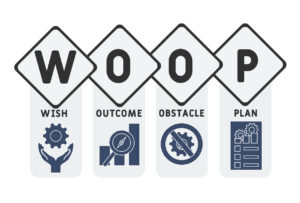
Wish
Outcome
Obstacle
Plan
Here’s how it works:
First, think of your goal. It could be to spend less time on your screen outside of work hours. But wait! That’s not specific enough. Proponents of the WOOP method suggest that merely having a goal isn’t enough, it has to be quantifiably specific and feasible to achieve. With that in mind, you could adjust your goal from the broad desire to reduce screen time to the more concrete aim of cutting your daily screen time by an hour by setting time limits on certain apps. That’s the wish.
Then, think of what the positives will be if you are able to achieve your goal—and again, be specific. Perhaps you’ll sleep better with less exposure to blue light during the day. Or maybe decreasing screen time can open up more space in the day to practice a hobby or to spend time with loved ones. While merely dreaming of the possibilities won’t do the trick, it helps to motivate action. Whether you’re setting aside five minutes to think this through, or writing it down in a notebook, take the time to envision the outcome.
The next step is to seriously consider the potential obstacles to achieving this goal. In this case, you might easily override a time limit on your apps. Or someone could ask to watch a YouTube video on your phone that sends you down a half-hour rabbit hole. Whatever it is, there will be plenty of things standing in the way. Instead of focusing solely on the positive, it’s beneficial to be realistic about what those obstacles are.
Once you have identified your obstacles, you can create plans to combat them. The method suggests thinking in terms of if/then plans. For instance: if I open an app and see that I have reached my daily time limit, I will not override it. Or, if I override my time limit on an app three times in one week, I will delete the app altogether. Understanding possible roadblocks and knowing how you’ll respond to them is the key.
Although it can get a bad rap, setting resolutions for the new year is a great way to start the year with strong intentions. It’s the follow-through that can be tricky. But whether it’s a personal goal or a professional one, it may be closer within reach than you think, if you give it a proper shot.
Written by Shani Laskin